Man: Hello, can I help you?
Student: Hi, I'm still a student but I've done a bit of research into the tea company
you work for and I have a few questions about the tea tasters jobs you have advertised.
Man: Well, that's actually what I do. Would you like me to tell you a bit about what
it's like being a trainee tea taster?
Student: Yes, please.
Man: Well, initially, even though there's some time spent in meetings at our office,
1a trainee is based in our lab
for most of their time being trained how to do the tasting.
Student: Right. How do you actually learn how to taste tea? Do you use a special kind of
cup?
Man: No, rather than that or even a glass to do the tasting, 2we sip it from a spoon.
Student: Ah, OK. And what other kind of things will I need to learn?
Man: Well, there are many different qualities of tea, so one of the most important
things is to learn how to decide which 3grade should be assigned to each sample.
Student: That's a very important part of the job.
Man: Yes, I can see why. And then another important thing to learn is how to choose the
right leaf for tea bags. Shape isn't nearly as important as the size in that case.
Student: Gosh, I'd never really thought about what goes into a tea bag. So do all of the
teas have their own 4name?
Man: Yes, that's another important part of the training. It took me ages before I
remembered them all.
Student: I can imagine. So how long before I qualify? I heard it was seven years, is
that right?
Man: Well, it used to be, but we've speeded things up a bit, so 5now it only takes five. That's two
years less than before, which is quite significant, really.
Student: Right, I see. The job sounds really interesting, but what I'd like to know
before applying is what kind of person you're looking for.
Man: Well, you need to have a degree.
Student: Well, that's fine. I'm just finishing mine.
Man: However, 6it doesn't have to be a science degree, even though that's a definite
bonus. My degree was in history, for example.
Student: I'm studying languages.
Man: Yes, that'll be fine. Is there anything else?
Man: Yes, 7you need to be able to do maths and do it fast. A lot of the job
is to do with the price of tea, so that's really important.
Student: OK, that makes sense.
Man: And this might seem unusual, but you'll have your sight tested. We're not worried
about whether you need glasses or not, that's fine, but 8you have to see colour accurately. It's very
important when looking at tea leaves.
Student: Wow, I'd never have thought about that, but it makes sense. What about other
things, like how important is good 9communication?
Man: Essential. You'll need to be highly skilled at that, as you'll meet such varied
people in this job, everyone from farmers to buyers.
Student: OK, I've noted that. Anything else I should remember?
Man: Yes, I'd say there's no point doing this job if you don't like to 10travel. You'll be
living out of a suitcase for a while.
Student: OK, well, thanks for all the information. You've been so helpful.
That is the end of Part 1.
Guide: Hello, everyone, and welcome to Pioneer Historical Village. It's an outdoor park
recreated to look just like a village from the mid-19th century. Visitors can wander through the
village, look inside the houses, and get a feel for what life was like back then.
The village has grown somewhat since it was first opened to the public, going back a bit, in 1962 a
committee was formed in the hope of preserving some of the local history. Many years of planning and
fundraising followed. Volunteers worked throughout the 1970s to restore and move buildings to the site.
11In 1980 the village
welcomed its first paying visitors.
We'll go in now, and I'll help you purchase your tickets. Since there are 10 of you all together in this
party, you qualify for the group discount. The normal price of admission is $16 for adults and $12.50
for students and seniors, but 12it'll only be $11 per person for all of you today, which is
quite a saving.
Sometimes we have shows and demonstrations. We had hoped to show you how candles are made, but the person
organising it had to cancel at the last minute. You're all in for a treat of another kind though. 13Just outside the shop we
have an expert sweet maker who will be making lollipops the old-fashioned way, so do go and
have a look. If you want to make bread yourself, head to the bakery and have a go. The space is quite
small though, so no spectators please.
You'll have a chance to interact with some farm animals today. We used to keep cows in the dairy, but
someone had to be here twice a day to milk them, and it became difficult to manage. Chickens are
everywhere though, not just on the farms. Every house kept a few for the eggs. 14You're welcome to have a look and see if
you can find any to collect. Goats were another favourite animal, but they cause trouble too.
They're fun to feed, but they eat everything in sight. The ones that we had have moved to a nearby farm.
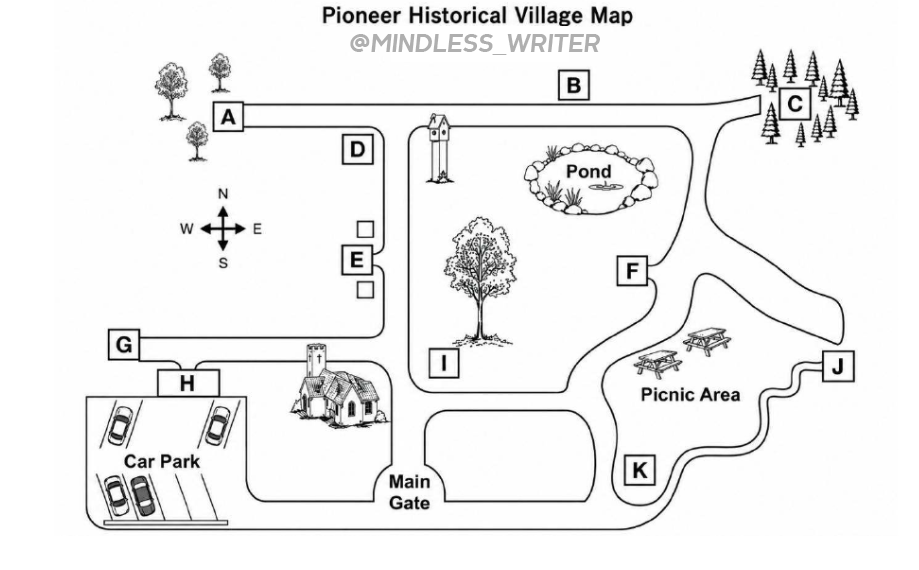
Now, you'll probably want some time to explore the village. Please open your maps and we'll have a look
at the layout. We'll enter through the main gate, which is at the bottom of your map. So, if you'd like
to see the schoolhouse, that's a good first stop because it's not too far from the gate.
If you head directly north, you'll come to a beautiful old church. 15The schoolhouse is diagonally across from it.
The mill is quite interesting. That's where they ground wheat to make flour for baking. 16To find it, go straight up
from the main gate until you get to the clock tower. Turn right and it's on the other side of the
road, across from the pond.
Then, there are the stables, where the horses were kept. 17You may have seen the back of the stables already
because they're a large building backing onto the car park. If you head west past the church, it's
the first building you come to.
Medical care was quite basic in those days. To get an idea of what it was like, you might like to visit
the doctor's office. 18Look
in the middle of your maps and it's in a block of three buildings that are all close
together. It's one of them.
There's even an old hotel. 19Go up past the picnic area and the hotel is on the opposite side of the
path, near the pond.
Another place to see is the workshop. 20It's at the end of that narrow winding path just south of the picnic
area, which is on the right-hand side of your map, at the eastern end of the village.
That is the end of Part 2.
You will hear two environmental study students, called Annie and Ryan, discussing with their tutor a
presentation they will give on disposing of dangerous household waste products.
Tutor: Hi, Annie, Ryan, come in.
Students: Morning.
Tutor: I know you want to discuss your project presentation. Start by reminding me what
you're focussing on.
Ryan: We've been looking at a research article on the disposal of hazardous household
waste. That includes things like dangerous chemicals we use in the home, but also less obvious items
like electrical equipment, which are potentially really polluting as well. The research basically
involved interviews, trying to find out what influenced the methods people use to get rid of their
dangerous waste.
Annie: There were some really surprising results about people's behaviour and attitudes
with regard to waste disposal.
Ryan: Yeah. It's no great shock that in general people are much more aware than they
used to be, you know, about the effects of these materials on the environment, and about the value of
careful disposal, even the smallest, cheapest things.
Annie: Yes, but I did think it was surprising that 21people don't get very enthusiastic about the subject
of waste disposal, like they do about other aspects of environmental protection.
Ryan: Me too. Apparently they find it all rather tiresome. Another striking thing was
that 22many people are more
careful when they're using certain hazardous materials than when they are getting rid of them. At
that stage, they simply don't remember that they'll be bad for the environment.
Annie: Absolutely. That really amazed us.
Tutor: I can see why. But were there any positives? Hope for the future?
Ryan: Well, in the conclusions section of the article, they talked about ways to improve
recycling rates in the local area. And I think some of the ideas would improve things around here, you
know. The article talked about laws in certain countries that certain types of waste have to be disposed
of safely or you are taken to court. I think financial penalties are a good idea, but criminalising
people is too harsh.
Annie: 23I
think it's more effective to impose a penalty on homes if they don't recycle stuff.
Ryan: I still think legislation forcing local councils to increase recycling rates works
better.
Tutor: You can present both ideas.
Ryan: Yeah, and agree to differ.
Annie: 24I
think encouragement is always better in the long run, and getting the local community involved, such
as schools, working with kids. That way you establish good habits which last throughout their
lives.
Tutor: Okay. Do you want to talk through your actual presentation?
Students: Yes, we thought we'd talk about different types of waste covered in the
research and give advice on each one.
Tutor: That's a great idea.
Ryan: We thought we'd start with paint.
Annie: Yeah, we'll explain that 25we advise setting up schemes where you can take it to a centre to be
used by people who need it, repainting an elderly person's home, for example, like they do in
many parts of the world.
Tutor: Yes, which is a positive note to start on. And will you discuss batteries?
Annie: Definitely. They're so small that they're the simplest things to drop in a bin
and forget. And I think we should emphasise that 26people should have a storage container at home where they can put them
until they've got enough to take to a central collection facility because they're full of
toxic substances.
Tutor: Medicines are really interesting. I imagine people don't think of them as
dangerous.
Ryan: No, indeed. The point we want to make is that, as a rule, 27things like antibiotics should not need
to be thrown away in the first place because doctors usually tell us we should finish off the whole
course of tablets. So there aren't any left to go for waste.
Tutor: Doubly good strategy. Are you discussing pesticides?
Ryan: Yes. 28The point we highlight from the article is that people are often unsure
what to do with them. And there needs to be clearer information given on the packaging so people are
left in no doubt.
Tutor: We thought we'd also look at tyres.
Annie: 29Rather than sending them to the dump, people should be encouraged to be
creative with them. Not just sending them away to be recut for retreads, but to make them into
things like plant holders for your garden.
Tutor: Good, yeah. And will you mention any electrical appliances?
Ryan: We've opted to finish with fridges because this is actually a good news story.
30The fact that we now have
the capacity to use less dangerous materials. And we should continue to exploit that capacity to
reduce effects on the ozone layer.
That is the end of Part 3.
You will hear part of a student presentation about a field trip to a whale shark research centre given to
fellow marine biology students.
Student: Hi everyone. I've just returned from my field trip and want to share some of my
experiences with you. I learnt a lot about whale sharks on this trip. For example, they're actually the
largest species of fish in the world's seas, about the size of a bus. Despite their massive size, whale
sharks are docile animals. Because of the name, you might be confused about whether these animals are
whales or sharks. They are in fact sharks, but they do have some things in common with whales.
They're similar in terms of their large size and what they eat. Like many species of whales, their diet
consists mainly of plankton and krill, which are tiny plants and animals. Unlike many whale species,
31they prefer to swim close
to the surface of the water rather than cruising the depths of the ocean.
So that's a key difference relating to their habits. Another one relates to their physical make-up. 32Their skeleton is made
entirely of cartilage, in comparison to whales that have skeletons made of real bones.
The place I visited is called Ningaloo in Western Australia. We were there to observe a large group of
whale sharks which congregate in that part of the ocean each year between April and July. Ningaloo is
ideal for whale sharks because there is a coral reef nearby which ensures an abundant supply of food.
It's great for divers too, because although it's in relatively deep waters, 33the reef is in close proximity to the
shore, unlike some reefs that you have to travel miles to get to.
I'd like to move on now to tell you about the Whale Shark Research Centre and the research being
conducted there. We know that whale sharks are migratory, but not a lot is known about where they go and
why. The methods currently being used to monitor them could be better. One way is to use an electronic
tracking device, or tag, which researchers have to 34attach manually to the fin. It's not an easy process, and the
tags are also quite expensive, so if it falls off, you're in trouble.
Another way of monitoring whale sharks is with 35a special drone to spot the animals in the ocean. This can give
you a rough idea of numbers, but obviously it's not an exact science.
The researchers at Ningaloo are involved in a new research project that's currently being carried out to
investigate whale shark feeding habits. They hope to find out more about how far whale sharks travel to
feed. They're using an innovative approach to do this, which analyses plankton. Apparently, 36plankton from different
places contains different quantities of carbon types.
The researchers are checking the plankton consumed by the whale shark against maps which have all the
different plankton zones marked on them. This comparison allows them to track exactly where the whale
shark has been feeding.
Some research that I was involved in on my field trip was directly observing the whale shark behaviour.
This was part of a small study being carried out in Ningaloo to find out how whale sharks are affected
by human activity. We drifted along in our boat with the engine off, then when a whale shark was nearby,
we switched on the engine. We noticed that the resulting noise affected the behaviour of the animal.
37As soon as it heard the
sound, we saw it dive. This happened on several occasions and was quite obvious.
One day, we got to witness the great work they're doing at the centre to educate the community about
whale sharks. At the moment, there's a whale shark race. 38The researchers select a mature whale shark which
has been tagged and they allocate it to a school. The children get to track the journey of
their whale shark and see which one travels the furthest. All the data is on the website.
It's clear that these majestic creatures require careful conservation and management. With humans and
whale sharks being in close proximity, problems can occur. While these events may be rare, 39all injuries which whale
sharks suffer must be documented, with information such as date and location and a photograph if
possible. The Fisheries Department has agreed to keep these records in their digital image
library.
Something that is being introduced next year in Ningaloo is a Code of Conduct. It covers the rules that
need to be followed to minimise any distress to the sharks. Scuba diving is not going to be allowed
anymore, as previous research has found that 40whale sharks find bubbles disturbing. Another new rule is that
boats...
That is the end of Part 4.