...for you to read the instructions and questions and you will have a chance to check your work. All the recordings will be played once only. The test is in four sections.
Write all your answers in the listening question booklet. At the end of the test, you will be given 10 minutes to transfer your answers to an answer sheet. Now turn to section 1 on page 2 of your question booklet.
You will hear a telephone conversation between a man who works for a library service and a woman who wants to join a library. First, you have some time to look at questions 1 to 5 on page 2. You will see that there is an example that has been done for you. On this occasion only, the conversation relating to this will be played first.
Good morning, library services. — Oh, good morning. My family and I have recently moved to the area and we'd like to find where our nearest library is. We don't have a car. — Right, so whereabouts are you? — In Perthon, in the west. (Example — west) — Fine, so I'll just get the details on screen for you.
The woman is asking about libraries in the west of the area, so west has been written in the space. Now we shall begin. You should answer the questions as you listen because you will not hear the recording a second time.
Listen carefully and answer questions 1 to 5. Good morning, library services. — Oh, good morning. My family and I have recently moved to the area and we'd like to find where our nearest library is. We don't have a car. — Right, so whereabouts are you? — In Perthon, in the west. — Fine, so I'll just get the details on screen for you.
Okay, your nearest one is the Minack library. — Minack? — Yes, in 1Skellarn Street. — Can you spell that? — It's S-K-E-L-L-A-R-N Street (harf-baharf shunday aytiladi; erkin nutqda bir marta "Skellen" ham eshitiladi — audioda ikkinchi marta tekshirish tavsiya etiladi). — Got that. It's very easy to find because it's 2beside a park.
Oh, I think I know that area. There's a sports centre near there, isn't there? — I don't know of one. — Oh, I'm probably mistaken. (sport markazi — chalg'ituvchi, xaritada/javobda yo'q)
Anyway, it's probably a bit far for us to walk from home. Are there any buses? — Yes, it's well served by public transport. There's a stop about five minutes' walk away.
Oh, right. And when does the library open? We'll most often want to come at the weekend. — I'm afraid it's not open on Sunday.
Saturday? — Opens at 9 o'clock, 3closes at 4.30. We shut at 5 on weekdays. — That's fine. Now, I've got two kids, 14 and 9, and I wondered whether you have any special activities for them.
In our last place, we had an art club. — Well, the library does run a 4drama club, but that would only be suitable for your younger child. It's open for 5 to 13 year olds.
A pity it's not open to both of them. Have you anything they could both go to? — Well, there's no reading club that would suit them both. Oh, but there's a 5singing club that's held every second Saturday afternoon for children of all ages up to 16.
Excellent. Before you hear the rest of the conversation, you have some time to look at questions 6 to 10 on page 2. Now listen and answer questions 6 to 10. Now, because we're new to the area, I'm also wanting to get involved in local activities.
Well, MNAC does some sessions for adults as well. There's a book of the month club. — That's good.
And I know that about once every 12 months, they have a session where you can meet 6artists, you know, from the local area. — How interesting. Well, that sounds like a full programme.
Now, while I'm on the phone, can I check what the facilities are? Can you take out CDs? — Not CDs, I'm afraid, but 7films, yes. — Right, I'll make a note of that. Anything else you need to know? — Oh, yes, we have 10 computers and we also stock several 8magazines, including business, health care and hobbies.
Same as my last place. And there is a new drop-off facility where you can post any item through the door if it's after hours. All you have to do is attach a note to it with the 9number on your card clearly written.
That sounds good. And we do have a small shop on the premises where we sell postcards. We don't have many, but it's a popular service.
Oh, that's a good idea. They're very popular. We also have an impressive range of 10maps of the surrounding area for sale.
Well, it sounds like you've got... That is the end of section one. You now have half a minute to check your answers.
Section two. You will hear the organiser of a family camp talking to a group of people who will be staying at a campsite. First, you have some time to look at questions 11 to 16 on page three. Now listen carefully and answer questions 11 to 16.
Hello, everyone, and welcome to this orientation session prior to our camp next week. Thank you for coming along to find out what you and your children will be doing on this year's camp. To start off with, let's tell you a bit about the campsite itself so that you'll be able to find your way around once you get there.
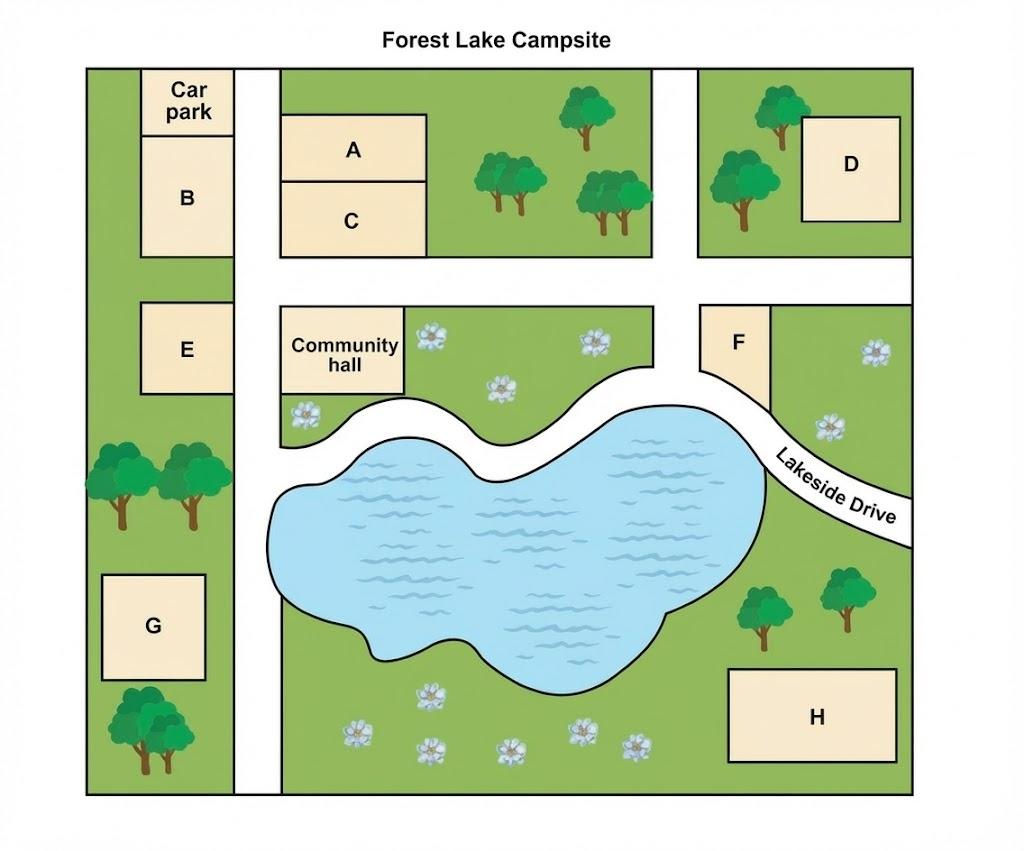
Firstly, we'll be arriving by bus into the car park, which if you look at the plan you have in front of you, you'll see at the top of the picture on the left-hand side. Now, if you cross the road from the car park, 11the first building you'll come to is the toilet block. It's been recently upgraded, so it's very nice and clean in there now with plenty of facilities.
And 12built onto that, so this is across the road from the community hall, is the new shower block. The hot water does run out occasionally, but usually there's enough to cope with a group your size. If you now move to the 13bottom left of your map, among the pine trees, there is a special flat site set up for pitching tents with power points and outdoor taps for water.
Now, let's go back and move along the top of your map. There's another area of pine forest, and then 14over on the far right-hand side, there's a block of small cabins. Note that this is different from the main accommodation block, which doesn't appear on this map, but is further over again to the right.
Now, let's look down from there, over the road, so we're moving clockwise around your map, okay? In this next block, 15beside the flowerbeds, we have a lovely place for barbecues, where you can cook in the open air. What else to tell you about? 16Below the flowerbed and across Lakeside Drive, you'll see a trail for mountain biking, which is always a popular activity. Moving on now, in the middle of the campsite, you'll see the lake where you can canoe, and above that again, the community hall.
So that completes your introduction to the campsite. I hope you found that useful. Before you hear the rest of the talk, you have some time to look at questions 17 to 20 on page four.
Now listen and answer questions 17 to 20. Now let's think about what you need to bring with you. I'm sure you're all wondering what you need to pack.
The lake is a bit cold for swimming at this time of year, so you can leave your togs out of the suitcase (C swimming toy — kerak emas, tuzoq). While we're on the subject of weather too, usually I recommend that campers bring sunblock with them, but I guess now that we're into April, that too can be left behind (B sunscreen — odatda kerak, lekin bu safar yo'q, tuzoq). Ah, let me think.
Some campers like a torch, but actually the days are still so long that it's light outside till quite late, and the blocks all have outside lighting now (D torch — kerak emas, tuzoq). So I'd say that 17a pair of earplugs are more useful, as in my experience, a lot of talking goes on after light's out. But in April, if it's wet, it can get muddy around the campsite, so 18to bring boots isn't a bad idea.
Finally, can you all please prepare something for the final night concert? Bring your musical instruments or whatever else you need. You can't have a camp without a good 19sing-along. That's our favourite activity.
Maybe you could recite a poem (C poetry recital — tuzoq), act out a skit or charades for us (A acting — tuzoq), if you're brave enough to try that. Or failing that, perhaps you can tell a joke or a funny story (E storytelling — tuzoq). But actually, people much prefer to see some good 20dancing.
I'll look forward to seeing you all perform next week. That is the end of section 2. You now have half a minute to check your answers.
Section 3. You will hear two music students discussing the results of a survey they have done.
First, you have some time to look at questions 21 to 26 on page 5. Now listen carefully and answer questions 21 to 26. So, Gareth, we need to organise the findings from our survey on music students for the final presentation. — Yes, Lorna.
I think we've got some very interesting results. Obviously, we need to start by saying that we interviewed all the third year students doing a music degree and state the objective of our research project, that is, to find out about their attitudes to performing. And then we should talk about the students' musical backgrounds before coming to university.
The most important points to make are that, although most people have actually composed music during the course, that wasn't the case when they arrived (A "allaqachon musiqa yozgan edilar" — tuzoq, aksincha kursda yoza boshlaganlar). And the other thing they had in common was the piano. Well, they'd had access to a piano at some point, but not all had studied it formally (E "piano darslari olishgan" — rasmiy dars emas, tuzoq).
I thought the most interesting finding was that before coming here, 21almost everyone was involved in a chamber orchestra or band or singing in a choir and playing in front of live audiences. But varying enormously in size. Some had only played in tiny venues.
I think it's worth saying that. OK. And as you might expect from people wanting to study music, 22they all had a degree of proficiency in at least two instruments.
But in most cases, one of the instruments was dominant. Right. We need to talk about attitudes to music practice.
The most striking thing here is that even students who you'd expect to practice for hours every day until they get it perfect, say 23it's being terrified of failing that really makes them practice. I know I'm the same. Me too.
It's interesting what was said about practicing alone. Some people preferred that because they could focus more on their weak points, but that wasn't a majority view (A "yolg'iz mashq qilishni afzal ko'radi" — ko'pchilik fikri emas, tuzoq).
What most of them agree on is that 24there's nothing more rewarding than mastering something that's really hard to learn. That's right. OK.
After that, we should talk a bit about the pieces that students select for assessed performances. There wasn't quite so much consensus on this, was there? A few people prefer to do pieces which are relatively unknown (B — ozchilik fikri, tuzoq), while others choose the ones they think will show off their technical ability, but they were in the minority (E — ozchilik fikri, tuzoq).
Hmm. I think the first thing to say is that 25a high percentage said they would always try to learn their pieces by heart because it's too easy to get lost if you're trying to read and play when you're nervous. OK.
And 26quite a lot of them said it helps to listen to other people playing your chosen piece, preferably recordings, but even just other students. Before you hear the rest of the discussion, you have some time to look at questions 27 to 30 on page 6. Now listen and answer questions 27 to 30. So finally, we need to look at the findings for students' attitudes to performing.
We should point out that this includes informal and formal public performances as well as assessed ones. Yes, that's important. I expected to find that performing solo would make students very nervous, but in fact, that isn't the case (D "juda asabiylashtiradi" — tuzoq, noto'g'ri). 27They do find it hugely challenging to start with, but they appreciate the challenge and find it stimulating. Right. I was surprised by what students said about deciding which pieces to perform.
I thought they'd all say this was easy (F "oson" — tuzoq, aslida qiyin). For me, it's always been quite straightforward. Which pieces do I like best and which pieces can I play well? And my repertoire is quite limited anyway.
But 28the most commonly cited answer was that it took them ages to make their minds up. I suppose it's because there are so many factors involved. You need to consider your audience, the venue, the time available to learn the piece, especially if it's complicated.
You need to think about all these things and you can't do that in a hurry. That's true. Then there's performing with musicians from a different genre, like a classical musician playing with a jazz group.
That can really be fun. But 29most of the music students had never even considered it. Right.
For performing with musicians who play the same instrument, almost everyone put the same thing. Yes. 30They all said it was incredibly helpful and not at all intimidating, which says a lot for the department's ethos.
Yes, that's a good point. Okay, what I think we should sort out now... That is the end of section three. You now have half a minute to check your answers.
Now turn to section four on page seven. Section four. You will hear a lecturer giving a talk to some engineering students about ethics and engineering.
First, you have some time to look at questions 31 to 40 on page seven. Now listen carefully and answer questions 31 to 40. Good afternoon.
Today we're starting a series of lectures on ethics in engineering, that is, engineering principles relating to right and wrong conduct and the sorts of moral responsibilities that you will have to uphold in your professional lives. I'm going to start by giving you a brief outline of the history of ethics in engineering. It was, of course, only in the 19th century that engineering really emerged as a profession.
Initially, 31ethical issues were considered to be a personal matter, something to be decided in accordance with one's own principles and values. However, things gradually changed as the profession grew and as engineering projects became larger and more complex. A need began to be felt for a more codified set of principles that all engineers would agree to follow.
Unfortunately, it took three major disasters to bring about this change in attitude. 32All three of these involved the collapse of bridges. The first, known as the Ashtabula River Railroad Disaster, happened in 1876 in the USA, and we now think it was probably caused by metal fatigue.
Then, in 1879, there was a second disaster, this time in Scotland. This occurred because engineers had failed to correctly calculate the 33effects that wind would have on the structure. The third collapse occurred in 1907 in Canada.
This was also due to an engineering design problem. 34The weight of the structure was so great that it could not support itself, and it collapsed. Public outcry over disasters such as these eventually led to the establishment of professional societies for engineers in most industrializing societies.
Another different type of disaster also had an impact on the development of professional engineering organizations, and I'd like to talk about this in a little more detail. This incident, which happened early in the 20th century, is known as the Boston Molasses Disaster. At the time, 35molasses was used rather than sugar as the principal sweetener in the USA.
It was also used in the manufacture of a number of other important products. One company in the city of Boston had a large amount of molasses waiting to be transferred to another factory. The molasses, more than eight million liters of thick, sticky liquid, 36was stored in a tank.
Suddenly, this collapsed, unleashing a wave of molasses up to five meters high. Nearby buildings were swept off their foundations and crashed to the ground. The wave also swept away a considerable stretch of railway track.
Many streets round the factory were covered with a thick layer of sticky brown molasses. Local residents were furious, as they felt that the company was to blame. They banded together and succeeded in bringing about 37a trial, charging the company with negligence.
After three years, the company was found responsible for the accident and required to pay out in damages the equivalent of six or seven million dollars in today's money. Even today, no one is absolutely sure about the immediate causes of the accident. However, it is certainly clear that 38not enough safety tests were carried out.
Had these been done in accordance with the standards now applicable, then the accident would almost certainly have been prevented. It seems that the collapse was probably brought about by 39fermentation of the molasses, which led to an increase in pressure. This increase probably exerted too much force against a fatigue crack or some other weakness.
However, this was one of the main incidents which led to increased legislation in the 1920s to regulate engineers and the engineering profession. It is the reason why 40we can now only operate if we have gained a licence. This requires us always to be conscientious about doing everything necessary to avoid disasters.
However time-consuming or expensive this may sometimes seem. Let's move on now to another... That is the end of section four. You now have half a minute to check your answers. Thank you.